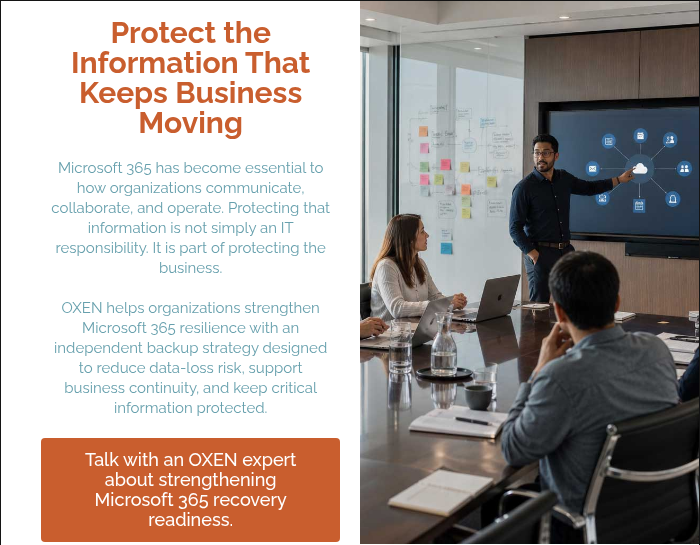

From Data Protection to Business Resilience: The Executive Value of Microsoft 365 Cloud Backup
Business leaders rarely measure the value of technology by the technology itself.
They measure it by outcomes.
Does it help the organization operate effectively?
Does it address meaningful business risk?
Does it support employees and critical processes?
Does it provide confidence that the organization is prepared when something goes wrong?
Microsoft 365 Cloud Backup should be evaluated through the same lens.
The ultimate objective is not simply to create another copy of data. The greater objective is to strengthen the organization's ability to protect critical information and recover when data loss threatens normal operations.
For leadership, that makes recovery readiness part of a broader business resilience strategy.
The Outcome Matters More Than the Backup
Backup is a function.
Resilience is an outcome.
That distinction matters because executives and IT professionals naturally view technology through different lenses.
Technology teams may consider whether critical Microsoft 365 information is being protected consistently. Leadership is more likely to consider what happens to the business if that information suddenly becomes unavailable.
Both perspectives matter.
The most effective strategy connects them.
Microsoft 365 backup therefore creates strategic business value when protection supports the organization's larger priorities around operational continuity, risk reduction, and recovery readiness.
Protect the Information Behind the Business
Microsoft 365 supports far more than productivity.
It can contain the information employees need to communicate, collaborate, coordinate activities, support customers, manage documents, and carry out everyday responsibilities.
Exchange Online, OneDrive, SharePoint, Teams, calendars, contacts, and tasks can all contribute to how employees work.
When information within that environment is unexpectedly lost, the business impact depends on what that information supported.
That is why leadership should avoid viewing Microsoft 365 protection solely as an IT responsibility.
Technology teams may manage protection.
The organization benefits from the outcome.
Strengthen Business Continuity
Business continuity is fundamentally about preparedness.
An organization cannot anticipate every event that could disrupt normal operations. It can, however, take deliberate steps to reduce unnecessary exposure and create recovery options before those options are required.
Microsoft 365 information should be part of that planning.
If critical information is lost, having an independent backup provides another potential path toward recovery.
The objective is straightforward:
Reduce the likelihood that one data-loss event becomes a larger operational problem.
That is a business outcome worthy of executive visibility.
Reduce Unnecessary Operational Risk
Risk management does not require eliminating every possible threat.
That would be unrealistic.
Instead, organizations identify meaningful exposures and determine how they can reduce the potential impact.
Microsoft 365 data loss represents one such exposure.
Accidental deletion, user error, ransomware, and other data-loss events can affect information employees rely on.
An independent backup strategy creates an additional layer of protection for that information.
For executives, the strategic value lies in reducing dependence on a single recovery path and preparing the organization before information becomes unavailable.
Risk may remain.
Uncertainty can be reduced.
Improve Confidence in Recovery Readiness
There is an important difference between assuming an organization can recover information and knowing the organization has deliberately prepared for recovery.
That difference is confidence.
Leadership should have visibility into several fundamental questions:
- What critical Microsoft 365 information is protected?
- Does that protection reflect how employees actually work?
- Does the organization maintain an independent backup?
- Are protection activities occurring consistently?
- Are responsibilities surrounding recovery understood?
- Does the approach support the organization's continuity objectives?
Executives do not need to manage the backup environment themselves.
They need assurance that recovery readiness has been considered as part of the organization's overall risk strategy.
Make Protection Consistent
Business resilience depends on preparation functioning before an event occurs.
That makes consistency important.
OXEN M365 Cloud Backup performs backups automatically on a scheduled basis, protecting information across Exchange Online, OneDrive, SharePoint, Teams, calendars, contacts, and tasks.
This allows Microsoft 365 protection to operate as an ongoing business safeguard rather than something that depends on employees remembering to protect individual information.
From an executive perspective, that simplicity matters.
Strong protection should support the organization without unnecessarily adding to everyday operational complexity.
Connect IT Decisions With Executive Priorities
Microsoft 365 backup can also help create a stronger connection between technology decisions and business objectives.
The CEO may focus on organizational resilience.
The CFO may look at reducing exposure to disruption.
The COO may prioritize continuity and the ability of employees to keep working.
An Executive Director or Business Owner may need confidence that limited organizational resources are appropriately protected.
The IT decision maker translates those priorities into technology and recovery strategies.
These perspectives do not compete.
They reinforce one another.
Technology protection becomes strategically valuable when it supports the outcomes leadership cares about.
Create Visibility Before a Crisis
A disruptive event is the wrong time for leadership to discover how its Microsoft 365 protection strategy works.
The better time is beforehand.
Executives should understand at a business level what is protected, where critical dependencies exist, how recovery responsibilities are addressed, and whether the organization's strategy reflects its continuity needs.
That visibility makes better decision-making possible.
It can expose assumptions.
It can highlight gaps.
Most importantly, it gives the leadership team an opportunity to address recovery readiness under normal business conditions rather than during an urgent event.
Protect Productivity and Operational Momentum
When business-critical information becomes unavailable, the consequences can extend beyond the information itself.
Employees may need to locate alternative sources of information, recreate work, seek assistance, or delay an activity while determining whether lost information can be recovered.
The business issue is therefore not simply data loss.
It is interruption.
A business-aligned protection strategy helps address that risk by maintaining an additional protected copy of critical Microsoft 365 information.
The value of that protection increases with the organization's dependence on Microsoft 365.
The more extensively employees rely on cloud-based information to perform their responsibilities, the more important recovery readiness becomes to operational continuity.
Make Resilience Part of the Strategy
The strongest Microsoft 365 data-protection strategies are not isolated IT projects.
They support larger organizational objectives.
Continuity.
Risk management.
Operational readiness.
Data protection.
Executive confidence.
Those outcomes shift the conversation from:
"Do we have backup?"
to:
"Are we prepared to recover the information the business depends on?"
That is a much more valuable leadership question.
It focuses attention on the organization rather than the technology.
Four Weeks, One Executive Conversation
The progression across the campaign leads to this point.
Week 1: Awareness
Microsoft 365 data loss can become a business risk.
Week 2: Education
Retention and independent backup serve different purposes.
Week 3: Solution Alignment
Microsoft 365 protection should reflect business priorities and operational dependencies.
Week 4: Business Outcome
Recovery readiness strengthens business resilience by supporting continuity, reducing operational exposure, and giving leadership greater confidence that critical information is protected.
The objective has never been backup for backup's sake.
The objective is preparation.
Organizations depend on information. Unexpected events can threaten that information. Leadership has an opportunity to prepare before those events occur.
Strong. Simple. Trusted.
Business resilience does not begin when disruption happens.
It begins with the decisions an organization makes beforehand.
OXEN M365 Cloud Backup provides scheduled protection for critical Microsoft 365 information across Exchange Online, OneDrive, SharePoint, Teams, calendars, contacts, and tasks.
For business leaders, however, the larger value is what that protection supports: stronger continuity, reduced operational risk, and greater confidence in recovery readiness.
Protect what matters. Prepare for the unexpected. Keep the business moving.
Strengthen Microsoft 365 Recovery Readiness
The best backup strategy is one that supports the larger goals of the organization.
Talk with an OXEN expert about Microsoft 365 Cloud Backup and explore how an independent data-protection strategy can help strengthen business continuity, reduce operational risk, and improve confidence in recovery readiness.