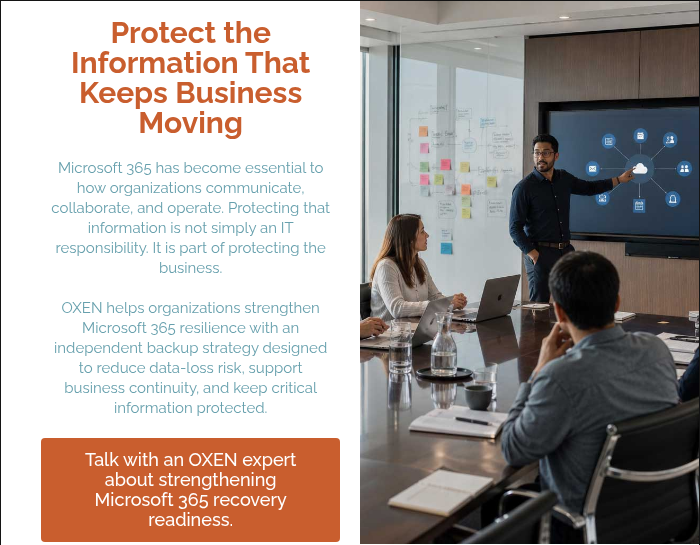

The Hidden Business Risk Inside Every Microsoft 365 Environment
For many organizations, Microsoft 365 has become part of the foundation of everyday business.
Employees communicate through Exchange Online. Documents and organizational information live within OneDrive and SharePoint. Teams supports collaboration. Calendars, contacts, and tasks help employees coordinate work and keep business moving.
Taken together, Microsoft 365 contains far more than files and email.
It contains information the business depends on.
That creates an important question for CEOs, CFOs, COOs, Executive Directors, Business Owners, and IT decision makers:
What happens to the organization when critical Microsoft 365 information is unexpectedly lost?
The answer should be part of a larger conversation about business continuity, operational risk, and organizational resilience.
Microsoft 365 Data Is Business Data
Technology discussions often describe data according to where it resides.
Leadership should consider it according to what it enables.
An email may contain important customer correspondence.
A SharePoint site may support an essential business process.
A OneDrive folder may contain documents required by an employee or department.
Teams information may support collaboration around important operational activities.
A calendar, contact, or task may contain information someone needs to move work forward.
That changes the significance of data loss.
The real business impact is not determined by the number of files affected. It is determined by what employees can no longer access or accomplish because the information is unavailable.
For leadership, that makes Microsoft 365 data protection part of a broader risk-management discussion.
The Risk Is Not Limited to a Major Disaster
A major cyberattack may be the scenario that attracts executive attention, but organizations do not need to experience a catastrophic event to lose important information.
Information can be affected by accidental deletion, user error, ransomware, or other data-loss events.
Sometimes an employee deletes something important.
Sometimes information is changed or overwritten.
Sometimes a cyber incident affects information the organization relies on.
Whatever the cause, the business ultimately faces the same fundamental question:
Can the information be recovered when it is needed?
That is why recovery readiness matters.
A resilient organization does not base its strategy on the assumption that information will never be lost. It considers how the business will respond when an unexpected event occurs.
Cloud Technology Does Not Eliminate the Recovery Conversation
Moving business information to the cloud provides organizations with powerful capabilities for communication, collaboration, and productivity.
But cloud adoption should not end the data-protection conversation.
Microsoft 365 includes native capabilities that help organizations manage information, but these capabilities should not automatically be viewed as a substitute for an independent backup strategy.
The executive issue is not whether Microsoft 365 offers protection mechanisms.
The more important issue is whether the organization's overall strategy provides the level of recovery readiness the business expects.
That distinction becomes especially important as an organization's dependence on Microsoft 365 grows.
Business Continuity Depends on Information
Business continuity planning traditionally focuses on preparing the organization to continue operating through unexpected disruption.
Technology availability is part of that equation.
So is information availability.
Consider a department that suddenly loses access to important historical communications, business documents, collaborative content, or other operational information.
The technology platform itself might still be functioning.
The employees might still have access to Microsoft 365.
But if the information they need cannot be recovered, business activity may still be affected.
That is the difference between focusing exclusively on system availability and considering true business resilience.
Leadership needs confidence not just that technology will operate, but that the information the organization depends on is appropriately protected.
Recovery Readiness Is an Executive Issue
Microsoft 365 backup may traditionally be considered an IT responsibility.
The technical implementation belongs with technology professionals. The business implications extend much further.
A CEO may view the issue through organizational resilience.
A CFO may consider the potential business impact of disruption.
A COO may focus on keeping operations moving.
An Executive Director or Business Owner may consider how data loss could affect employees, customers, and organizational obligations.
An IT decision maker is responsible for translating those priorities into an appropriate technology strategy.
Each perspective leads back to the same issue:
How prepared is the organization to recover critical Microsoft 365 information?
Executives do not need to understand every technical component of a backup platform to ask the right business questions.
Questions Leadership Should Be Asking
An executive Microsoft 365 data-protection conversation can begin with several straightforward questions:
- What Microsoft 365 information is essential to everyday operations?
- What would happen if that information suddenly became unavailable?
- Does the organization maintain an independent backup of critical Microsoft 365 data?
- Does protection extend across the Microsoft 365 services employees actually use?
- Who understands the organization's recovery process?
- Does the current approach align with business continuity and data-protection objectives?
The purpose of these questions is not to turn leadership into backup administrators.
It is to create visibility.
Leadership cannot appropriately evaluate an organizational risk if it does not understand the organization's readiness.
An Independent Layer of Protection
One way organizations strengthen Microsoft 365 resilience is by maintaining an independent backup of critical information.
OXEN M365 Cloud Backup provides scheduled, cloud-based protection for Exchange Online mailboxes, OneDrive files, SharePoint content, Teams assets, calendars, contacts, and tasks.
Backup information is maintained in encrypted cloud storage, providing an additional layer of protection beyond the organization's production Microsoft 365 environment.
For the executive team, however, the underlying technology is not the most important part of the conversation.
The outcome is.
Independent backup gives the organization another recovery option when critical information is lost.
That additional protection can help strengthen business continuity, reduce operational exposure, and improve confidence in recovery readiness.
Protection Should Reflect How the Business Operates
Modern employees do not work within a single application.
They move between email, documents, shared resources, collaboration environments, calendars, contacts, and tasks throughout the day.
A Microsoft 365 protection strategy should reflect that interconnected environment.
Leadership should therefore look beyond whether the organization "has backup" and consider whether its strategy protects the information employees actually depend on.
This creates a better executive standard:
Protection should align with business dependency.
The more important Microsoft 365 becomes to operations, the more important it becomes to understand how critical information is protected and recovered.
Move From Assumption to Preparedness
One of the greatest vulnerabilities in continuity planning is assumption.
Leadership may assume everything in Microsoft 365 can be recovered.
Employees may assume deleted information can always be retrieved.
An organization may assume its existing protections provide everything the business requires.
Those assumptions often remain untested until information is needed.
A better approach is to establish recovery expectations before an incident occurs.
Organizations should understand what they are protecting, why it matters to the business, and how that protection supports continuity.
That transforms Microsoft 365 backup from a technology task into part of a broader resilience strategy.
The Executive Question Has Changed
Historically, leadership might have asked:
"Is our Microsoft 365 data backed up?"
That question is still useful, but it is incomplete.
A stronger executive question is:
"If critical Microsoft 365 information were lost tomorrow, how confident are we that the organization could recover what it needs to continue operating?"
That shift is important.
It changes the conversation from technology ownership to business preparedness.
It focuses attention on operational continuity.
It makes data protection part of organizational risk management.
And it encourages leadership to understand recovery readiness before a disruption exposes a weakness.
Strong. Simple. Trusted.
Organizations cannot prevent every accidental deletion, user mistake, ransomware event, or unexpected disruption.
They can prepare for them.
OXEN helps organizations establish an additional layer of protection for critical Microsoft 365 information, supporting stronger business continuity and greater confidence in recovery readiness.
Effective data protection does not need to become complicated.
It begins with understanding what the business depends on, identifying where meaningful risk exists, and ensuring critical information is appropriately protected.
Is Your Microsoft 365 Data Recovery Ready?
The best time to evaluate recovery readiness is before critical information is lost.
Talk with an OXEN expert about Microsoft 365 Cloud Backup and explore how an independent backup strategy can help reduce operational risk, strengthen business continuity, and improve confidence in the organization's ability to recover.