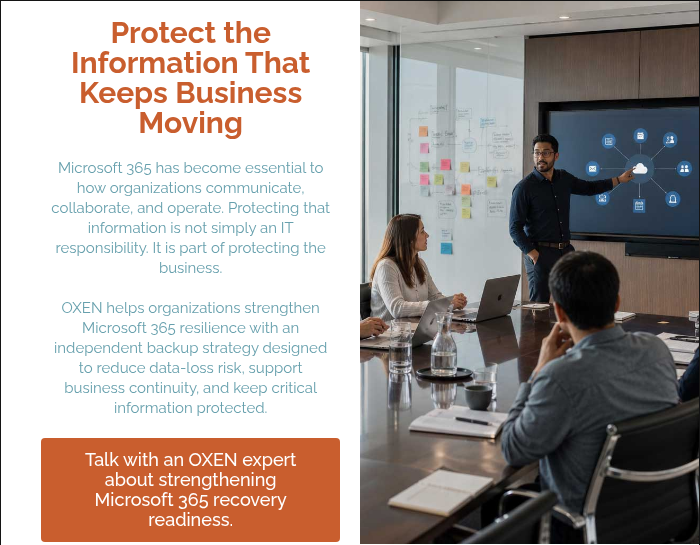

Building a Microsoft 365 Recovery Strategy Around the Business
An effective Microsoft 365 backup strategy should not begin with technology.
It should begin with the business.
Organizations increasingly depend on Microsoft 365 to communicate, collaborate, manage information, coordinate activities, and support everyday operations. As that dependence grows, leadership needs more than confirmation that backups exist.
Executives need to understand whether the organization's data-protection strategy supports the way the business actually operates.
That creates a better question:
Does the organization's Microsoft 365 recovery strategy align with its business priorities?
For CEOs, CFOs, COOs, Executive Directors, Business Owners, and IT decision makers, answering that question moves the conversation beyond backup and toward business resilience.
Start With the Business, Not the Technology
Backup technology is a means to an end.
The business objective is maintaining access to critical information and creating recovery options when unexpected data loss occurs.
That distinction should influence how leadership evaluates Microsoft 365 protection.
Instead of beginning with storage, schedules, or technical configurations, organizations can begin with a series of business questions:
- Which information is essential to operations?
- Where does that information reside?
- Which teams and business processes depend on it?
- What would happen if it became unavailable?
- How prepared is the organization to recover?
- Do protection efforts reflect the organization's actual business priorities?
These questions establish the business requirements first.
Technology can then be aligned with those requirements.
Protect the Way Employees Actually Work
Microsoft 365 is not a single business application.
Employees may begin their day in Exchange Online, collaborate through Teams, work on files in OneDrive, access organizational information through SharePoint, and rely on calendars, contacts, and tasks to keep work moving.
That interconnected environment means data protection should reflect how the organization actually operates.
OXEN M365 Cloud Backup provides scheduled protection across Exchange Online mailboxes, OneDrive files, SharePoint content, Teams assets, calendars, contacts, and tasks.
This broader approach matters because business dependency does not necessarily stop at the edge of one application.
If employees depend on information across Microsoft 365, the organization's protection strategy should account for that reality.
Protection should align with business dependency.
Make Continuity the Objective
Executives rarely invest in business technology simply because of its technical specifications.
They invest to achieve an outcome.
The same principle applies to backup.
Creating backup copies is the function. Strengthening the organization's ability to recover is the larger business objective.
Consider the issue from an operational perspective.
When employees lose critical information, leadership is less concerned about the underlying backup architecture than it is about what happens next.
Can employees continue working?
Can important business information be recovered?
Can operational disruption be contained?
Does the organization understand its recovery process?
Those questions connect data protection directly to business continuity.
Reduce Operational Complexity
A strong recovery strategy should also consider the operational burden placed on employees and internal IT resources.
Routine protection should be consistent.
OXEN M365 Cloud Backup performs backups automatically on a scheduled basis and stores backup information in encrypted cloud storage.
For the organization, this creates an opportunity to maintain ongoing protection without turning routine backup activity into another employee-managed business process.
That simplicity has strategic value.
Internal IT resources have competing priorities. Business leaders do as well. Protection should work in support of those priorities rather than unnecessarily compete with them.
The objective is straightforward:
Make data protection strong enough to support the business and simple enough to manage effectively.
Give Leadership the Right Visibility
Executive visibility does not mean CEOs and CFOs should begin monitoring backup systems.
It means leadership should understand the organization's readiness at a business level.
Executives should be able to ask:
- What critical Microsoft 365 information is being protected?
- Does protection reflect the services employees depend on?
- Are backups occurring consistently?
- Does the organization maintain an additional protected copy of critical information?
- Who understands the recovery process?
- Does the overall approach support business continuity requirements?
These are governance questions rather than administrative ones.
They give leadership a clearer view of organizational exposure without forcing executives into technical details.
That visibility is essential because a risk that is not understood is difficult to manage strategically.
Match Protection to Risk
Not every organization has the same operating model, priorities, regulatory considerations, or tolerance for disruption.
That is why Microsoft 365 data protection should not be approached as a checkbox.
A business that depends heavily on Microsoft 365 should understand that dependency and consider the potential operational impact of losing critical information.
Leadership can then evaluate whether its protection strategy appropriately reflects that exposure.
For a CEO or Business Owner, that may mean considering overall organizational resilience.
For a CFO, it may mean considering exposure to operational disruption.
For a COO, it may mean ensuring employees and business processes can continue functioning.
For an Executive Director, it may mean balancing continuity requirements against available organizational resources.
For an IT decision maker, it means translating those business priorities into an appropriate data-protection strategy.
Different perspectives. One common objective.
Keep critical business information protected and recoverable.
Define Recovery Expectations Before They Are Needed
A backup strategy is only part of recovery readiness.
Organizations also need to understand what happens when information needs to be recovered.
Who identifies what is missing?
What information is considered business-critical?
Who initiates the recovery request?
What does leadership expect the recovery process to accomplish?
These conversations are far more valuable before an incident occurs.
Without defined expectations, organizations can discover a gap between what leadership assumed would happen and what the existing recovery strategy was designed to support.
Prepared organizations reduce that uncertainty.
They establish clearer expectations around protection and recovery before data loss turns those expectations into urgent business questions.
Move Beyond the Backup Checkbox
It can be tempting to reduce Microsoft 365 protection to one question:
"Do we have backup?"
But a yes-or-no answer provides limited insight into the organization's actual readiness.
Leadership needs a more complete view.
What is being protected?
Does protection reflect how employees work?
Does the strategy align with operational requirements?
Are responsibilities understood?
Does the organization have confidence in its ability to respond when critical information is lost?
These questions transform backup from an IT checkbox into part of a broader resilience strategy.
Align Technology With Business Outcomes
The most effective technology strategies connect directly to organizational priorities.
Microsoft 365 data protection should be no different.
OXEN helps organizations establish an additional layer of protection for business-critical Microsoft 365 information while keeping the larger objective in focus: supporting continuity and improving recovery readiness.
Automated, scheduled protection helps address the technology requirement.
Coverage across Microsoft 365 helps align protection with the environment employees use.
Encrypted cloud storage helps establish another protected location for backup information.
But those capabilities are not the end goal.
Their value comes from how they contribute to the organization's ability to prepare for and respond to data loss.
From Backup to Business Resilience
Over the first three weeks of this campaign, the executive conversation progresses:
Week 1: Awareness
Microsoft 365 data loss can become a business risk.
Week 2: Education
Retention and independent backup serve different purposes.
Week 3: Solution Alignment
Data protection should align with the organization's business priorities and recovery expectations.
That progression leads to a broader conclusion.
Backup should not exist simply because technology best practices say an organization needs it.
It should exist because the business depends on information, disruption is possible, and leadership wants greater confidence that critical data can be recovered when needed.
That is where backup becomes business resilience.
Strong. Simple. Trusted.
A Microsoft 365 recovery strategy does not need to become an unnecessarily complicated executive initiative.
It can begin with three straightforward priorities:
Protect what matters. Understand how recovery works. Align protection with the business.
OXEN M365 Cloud Backup helps organizations protect critical Microsoft 365 information across Exchange Online, OneDrive, SharePoint, Teams, calendars, contacts, and tasks through automated, scheduled cloud backup.
The technology provides the protection.
The strategic value comes from what that protection supports: stronger recovery readiness, reduced operational risk, business continuity, and greater confidence when the unexpected occurs.
Align Microsoft 365 Protection With the Business
The right backup strategy does more than protect information. It supports the organization's ability to keep moving when critical data is unexpectedly lost.
Talk with an OXEN expert about Microsoft 365 Cloud Backup and explore how a business-aligned data-protection strategy can strengthen continuity, reduce operational risk, and improve recovery readiness.