

The Question Every Board Should Be Asking: Is Your Organization Still Insurable?
Cyber insurance has evolved from a niche coverage consideration into a critical component of organizational risk management. Yet many executive teams continue to operate under a dangerous assumption: because they have cyber insurance today, they will be able to obtain it tomorrow and successfully collect on it when an incident occurs.
That assumption is becoming increasingly risky.
Over the last several years, ransomware attacks, business email compromise, data breaches, and supply chain disruptions have reshaped the cyber insurance market. Insurers have responded by increasing underwriting scrutiny, raising security expectations, and demanding greater accountability from policyholders. Organizations that once qualified for coverage with minimal review are now facing detailed security questionnaires, technical audits, and stricter renewal requirements.
The reality is simple: insurance carriers are no longer evaluating organizations solely on revenue, industry, or claims history. They are evaluating cybersecurity maturity.
For executives, that raises an important question:
Is your organization actually insurable in today's environment?
Cyber Insurance Has Become a Business Requirement
The discussion surrounding cyber insurance is no longer limited to IT departments.
Boards of Directors, executive leadership teams, financial officers, lenders, investors, and customers increasingly recognize cyber incidents as business risks rather than technology issues.
Modern cyber events can disrupt operations, halt revenue generation, damage customer trust, trigger legal action, create regulatory concerns, and burden organizations with significant recovery costs.
As a result, cyber insurance has become an essential risk-transfer mechanism for many organizations.
However, insurance providers are also experiencing significant losses from cyber claims. To reduce exposure, they are placing greater emphasis on prevention and preparedness.
Rather than asking, "Do you want cyber insurance?" insurers are increasingly asking:
- How mature is your cybersecurity program?
- What controls have you implemented?
- How are those controls managed and documented?
- Can you demonstrate ongoing risk management?
Organizations that cannot confidently answer those questions may find themselves facing higher premiums, restricted coverage, or challenges obtaining coverage altogether.
The New Reality of Cyber Insurance Underwriting
Today's cyber insurance applications require more than checking a few boxes.
Insurance providers increasingly want evidence that critical cybersecurity controls are implemented, monitored, and actively maintained.
Areas frequently examined include:
- Multi-Factor Authentication (MFA)
- Endpoint protection
- Vulnerability management
- Security awareness training
- Incident response planning
- Backup and recovery capabilities
- Access controls and privileged account management
Executives are often surprised to learn that having technology in place is no longer enough.
Insurers want confidence that controls are functioning effectively and consistently across the organization.
A cybersecurity tool that is partially deployed or poorly managed may provide little value during underwriting reviews.
This shift is changing the conversation from technology purchases to cybersecurity governance.
Why Insurability Is an Executive Responsibility
Many business leaders still view cybersecurity as an IT responsibility.
While technology teams play a critical role, insurability ultimately reflects broader organizational decisions.
Questions regarding cybersecurity readiness often involve:
- Budget allocation
- Risk tolerance
- Policy enforcement
- Employee accountability
- Vendor management
- Business continuity planning
- Executive oversight
In other words, the organization's insurability is influenced by leadership decisions as much as technical controls.
Boards and executive teams should view cyber insurance readiness similarly to financial audits, regulatory compliance initiatives, or operational governance programs.
The organizations most likely to qualify for favorable coverage terms are often those that treat cybersecurity as a business priority rather than a technology project.
The Cost of Waiting
A common misconception is that cyber insurance issues only surface during annual policy renewals.
Unfortunately, organizations often discover gaps when they have the fewest options available.
Coverage concerns may emerge when:
- Renewals are due
- New coverage is sought
- Security questionnaires are reviewed
- Claims are submitted following an incident
By that stage, organizations are often operating under compressed timelines and heightened pressure.
The better approach is proactive preparation.
Understanding insurer expectations before coverage discussions begin creates opportunities to address deficiencies, improve controls, and strengthen the organization's overall cybersecurity posture.
Five Questions Every Executive Team Should Ask Today
Organizations seeking to evaluate their readiness should begin with five practical questions:
1. Could We Demonstrate Our Security Controls Today?
Knowing controls exist and proving they exist are very different things. Documentation matters.
2. Are Critical Security Controls Fully Implemented?
Partial adoption often creates gaps that underwriters view as risks.
3. How Frequently Do We Assess Vulnerabilities?
Cyber threats evolve continuously. Security programs must evolve as well.
4. Could We Respond Effectively to a Cyber Incident?
Prepared organizations typically recover faster and experience less disruption.
5. Would Our Insurance Provider View Us as a Lower-Risk Organization?
Understanding how insurers evaluate risk can help guide cybersecurity investments and business decisions.
Join the Discussion With OXEN's Experts
Cyber insurance is no longer simply about purchasing a policy. It is about demonstrating that the organization has taken reasonable and defensible steps to reduce cyber risk.
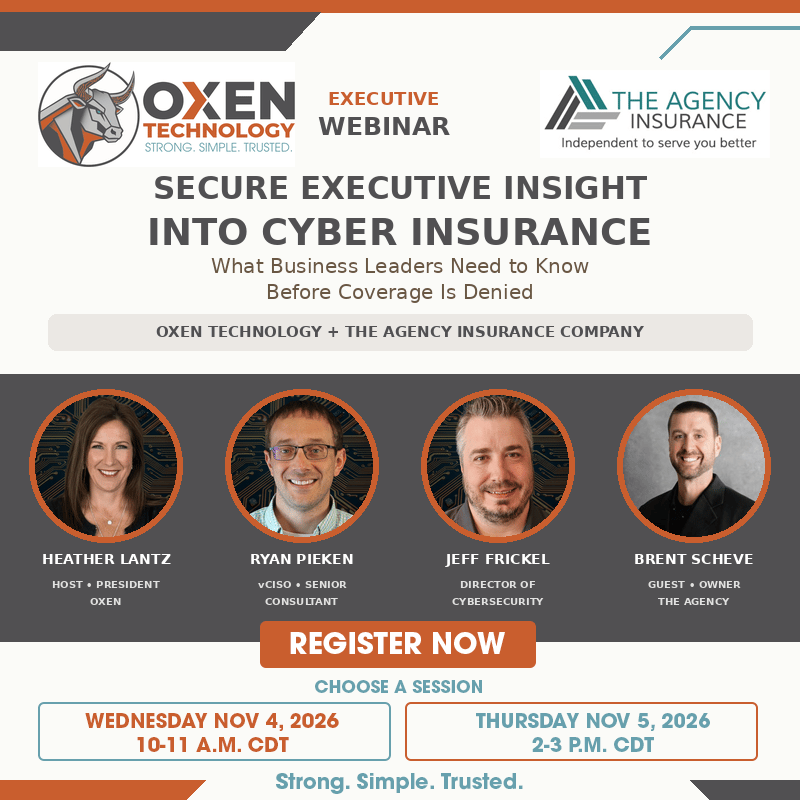
To help business leaders better understand today's insurance landscape, OXEN Technology and The Agency Insurance are hosting an executive webinar designed specifically for organizational decision-makers.
Attendees will learn:
- Why cyber insurance requirements continue to evolve
- What insurers now expect from applicants
- Common factors that impact coverage decisions
- Why claims are sometimes denied
- Practical steps leaders can take to improve cyber insurance readiness
- How cybersecurity and cyber insurance work together to reduce organizational risk
The session will feature insights from:
- Heather Lantz, President, OXEN Technology
- Ryan Pieken, Senior Consultant, CIO/CISO Services
- Jeff Frickel, Director of Cybersecurity
- Brent Scheve, Owner, The Agency Insurance
For executives responsible for protecting their organizations, this is an opportunity to gain practical guidance from professionals who work with cybersecurity and cyber insurance challenges every day.
Register Today
The question is no longer whether cyber insurance matters.
The question is whether your organization is prepared to meet the expectations that come with it.
Register today for Secure Executive Insight Into Cyber Insurance: What Business Leaders Need to Know Before Coverage Is Denied and learn how to strengthen both your cybersecurity posture and your insurability.