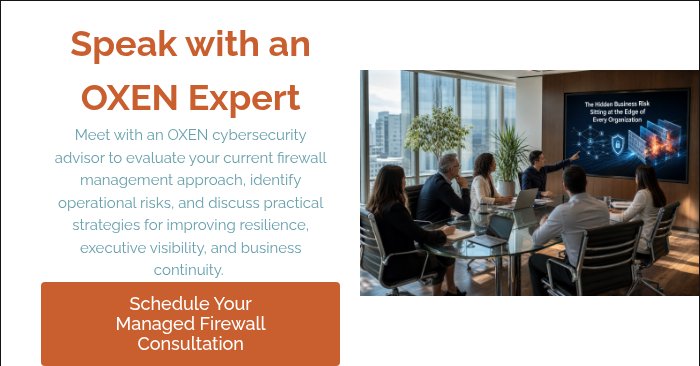

The Hidden Business Risk Sitting at the Edge of Every Organization
Business leaders spend considerable time evaluating risk. Financial risk. Operational risk. Regulatory risk. Strategic risk.
Yet one of the most significant sources of organizational risk often receives far less executive attention than it deserves.
It sits quietly at the edge of the network.
The firewall.
For many organizations, the firewall is viewed as a completed project. Hardware was purchased, the solution was installed, and security controls were configured. Leadership checks the box and moves on to more pressing business priorities.
Unfortunately, cyber threats, business requirements, and organizational technology environments do not remain static.
The firewall that protected the organization yesterday may not be configured to address the realities of today.
According to OXEN's Managed Firewall Services documentation, effective firewall security requires continuous monitoring, configuration management, security policy management, threat prevention capabilities, alert investigation, reporting, and ongoing oversight to remain aligned with business needs.
The issue is not whether a firewall exists.
The question is whether it is actively managed.
The Difference Between Having Protection and Managing Protection
Many organizations assume the presence of a firewall automatically reduces risk.
While deployment is an important first step, security controls are most effective when they are continuously maintained and monitored.
Business environments evolve constantly:
- Employees work remotely.
- New applications are introduced.
- Vendors require access.
- Cloud services expand.
- Offices relocate.
- Business priorities shift.
Every change introduces potential security implications.
Firewall policies that were appropriate twelve months ago may no longer align with operational requirements today. New access rules are often added over time, while outdated permissions remain in place. Security policies can become increasingly complex and difficult to manage without regular oversight.
OXEN's service model includes ongoing configuration management, policy reviews, monitoring, and reporting specifically because firewall effectiveness depends on continuous alignment with the organization it protects.
Why Executive Teams Should Care
Firewall management is often viewed as an IT responsibility.
In reality, the outcomes directly impact executive priorities.
Chief Executive Officers care about organizational resilience.
Chief Financial Officers care about financial stability and risk reduction.
Chief Operating Officers care about business continuity and operational performance.
Executive Directors care about mission delivery and stakeholder confidence.
Business owners care about protecting growth, reputation, employees, and customers.
Every one of these priorities depends on reliable and secure operations.
A security incident can disrupt productivity, delay customer service, interrupt revenue-generating activities, and create significant reputational challenges. While no security control can eliminate risk entirely, proactive management helps reduce the likelihood that preventable issues become business problems.
This is where executive visibility becomes important.
Leaders need confidence that critical safeguards are not simply installed but actively monitored and maintained.
Risk Often Builds Quietly
One of the most challenging aspects of cybersecurity risk is that it rarely announces itself.
Risk accumulates gradually.
A policy is never reviewed.
A firmware update is delayed.
A temporary access rule becomes permanent.
Business changes outpace security changes.
Over time, small gaps can create larger exposure.
Because these issues develop incrementally, organizations may not recognize them until an audit, outage, or security event reveals the problem.
OXEN's Managed Firewall Services emphasize continuous monitoring, alert investigation, firmware maintenance, security visibility, and policy management to help address these challenges before they impact operations.
The Connection Between Security and Resilience
Resilient organizations understand that cybersecurity is not merely a technical function.
It is a business function.
The goal is not simply blocking threats.
The goal is maintaining operational continuity.
When leaders evaluate cybersecurity investments through a resilience lens, the conversation changes.
Instead of asking:
"Do we have a firewall?"
The better question becomes:
"Do we have confidence that our firewall is being actively managed to support our business objectives?"
That distinction matters.
A managed approach provides continuous oversight, improved visibility, and ongoing adaptation as business and security requirements evolve. Organizations gain confidence that critical protections remain aligned with their operational needs while internal teams remain focused on strategic initiatives.
Strong. Simple. Trusted.
Today's organizations need more than security equipment.
They need confidence.
They need visibility.
They need resilience.
Most importantly, they need assurance that critical security controls continue to support business operations as the organization grows and changes.
Managed Firewall Services help transform firewall security from a technical responsibility into a strategic business asset by providing ongoing monitoring, management, reporting, and expert oversight.
The strongest organizations are not those that assume their protections are working.
They are the organizations that continuously verify, manage, and improve them.
That is how resilience is built.
That is how risk is reduced.
That is how business leaders gain confidence in the future.