



IT disruptions don't just cause delays; they drain productivity and bleed revenue. Yet, many businesses still rely on reactive "break-fix" support, only calling for help when something goes wrong.
According to Trilio, small businesses lose an average of $427 per minute, and larger ones lose about $9,000 per minute when downtime and ongoing IT issues happen. These aren't just technical glitches; they're strategic liabilities.
It's time for a shift. Businesses need proactive, preventive IT strategies that anticipate problems before they surface. Managed services offer exactly that: consistent, monitored support designed to keep systems running smoothly and securely.
As Ryan Pieken, Senior Consultant CIO, CISO Services, OXEN Technology, puts it: "In a business environment that never hits pause, the choice of IT support is a lifeline, not a luxury. Break-fix is a gamble. Managed services are the plan."
This blog breaks down the differences between break-fix and managed services so you can choose the model that keeps your business resilient, efficient, and future-ready.
Break Free from Break-Fix!Stop waiting for something to go wrong. Start getting support that prevents downtime and protects revenue. |
What Are Break-Fix Services? Why Do Some Businesses Still Use Them?
Break-fix services are a pay-as-you-go form of IT support. You call a technician only when something breaks. You pay for the work done and the parts needed. There are no monthly plans, no regular checkups, and no long-term relationship with the provider.
This can seem cheaper at first. If your business uses very little technology or has someone in-house who can handle basic issues, you might think break-fix is good enough. The provider only shows up when asked, and you pay only when they work.
Some businesses still use break-fix services for reasons like:
- Budget control: Small businesses think this model helps them spend less because there are no regular fees.
- Simple technology setup: If the setup is basic, it might seem like regular support isn't necessary.
- One-time problems: Businesses might only need short-term help or a quick fix for an issue.
These reasons can seem valid. But without regular support, small problems grow and lead to major disruptions.
Managed Services Offer More Than Just IT Support
Managed services give you ongoing, full-time IT support. Instead of waiting for things to break, your provider watches your systems all the time and keeps them working smoothly. This includes monitoring, helpdesk support, cybersecurity protection, cloud backups, and more.
Managed Service Providers (MSPs) use tools to check your systems 24/7. They solve problems before they become serious. You don't have to wait until something goes wrong. The provider is already fixing it in the background.
When you choose managed services, you get:
- 24/7 monitoring: Your systems are watched around the clock to catch issues early. This helps keep your network running smoothly and reduces the risk of outages.
- Cybersecurity support: Your business is protected with tools and practices that help block phishing, malware, and other threats before they cause damage.
- Reliable backups: Your files and systems are backed up automatically and tested regularly. This ensures you can recover quickly if data is lost or systems go down.
- Fast, local support: You get help from a nearby team that understands your setup. This means faster problem-solving with less confusion and no long wait times.
Managed services are not just about fixing things. They give your business stability and a stronger foundation to work and grow.
Break-Fix vs Managed Services: Comparing Costs, Control, and Consequences
Choosing between break-fix vs managed services means looking at more than price. You need to look at how each model affects your business's future, safety, and daily operations.
1. Reactive vs Proactive Approach
Break-fix is a reactive approach. You wait until something fails, then call for help.
Managed services are proactive. Problems are often found and fixed before they cause any damage. For example, if a backup fails or a system needs a software update, your provider will handle it automatically.
This matters. IBM reports that the average time to detect a cybersecurity incident is 204 days. Waiting for visible problems means you could be vulnerable for months.
2. Predictable Cost vs Variable Cost
Break-fix may seem cheaper at first. You only pay when help is needed, but unexpected issues can lead to large, unplanned bills. One server crash could cost thousands.
Managed services charge a fixed monthly fee. You know your costs and can plan your IT budget better. Nearly 50% of businesses working with an MSP have cut their annual IT costs by at least 24%, and another third saved between 25% and 49%. These savings add up quickly, especially when your systems are consistently running efficiently, not just getting fixed when they fail.
3. Operational Risk
Break-fix providers don't take responsibility for your systems unless you call. That means longer downtimes and slower service.
MSPs take full responsibility for keeping your systems running. They track their performance using service level agreements (SLAs), so you know what to expect and when.
| More resources you might like: |
The Hidden Risks of Relying on Break-Fix Services
Break-fix services may seem simple, but they leave out many important tasks. When no one is watching your systems daily, small problems can degenerate and become critical.
Here are the main risks:
- Slow detection of problems: Issues often go unnoticed until systems crash or files go missing.
- Outdated software: Without regular updates, your systems become vulnerable to attacks.
- No clear ownership: No one is looking out for the overall health of your network.
- Weaker security: There is no real-time monitoring, which makes it easier for threats to go unnoticed.
This model also affects your employees. When they lose access to files or wait hours for IT support, their productivity drops.
Why More SMBs Are Moving Toward Managed Services
Small and medium-sized businesses are switching to managed services because they offer more support and fewer risks.
This model fits today's needs, which include better security, data backup, compliance, and employee support.
Benefits include:
- Lower long-term costs: One monthly bill helps you avoid large surprise expenses.
- Stronger security: Managed providers handle updates, antivirus, MFA, and training to reduce risks.
- Easier compliance: If you work in finance or utilities, managed services help you meet industry rules.
- Better productivity: Your team stays focused, not stuck waiting for IT help.
The report found that 75% of businesses report that security has become a bigger business priority. With increasing threats, more businesses are choosing managed services for peace of mind.
Break-Fix vs Managed Services: Which One Makes Sense for Your Business?
The choice between break-fix vs managed services directly affects your IT budget, risk, and performance.
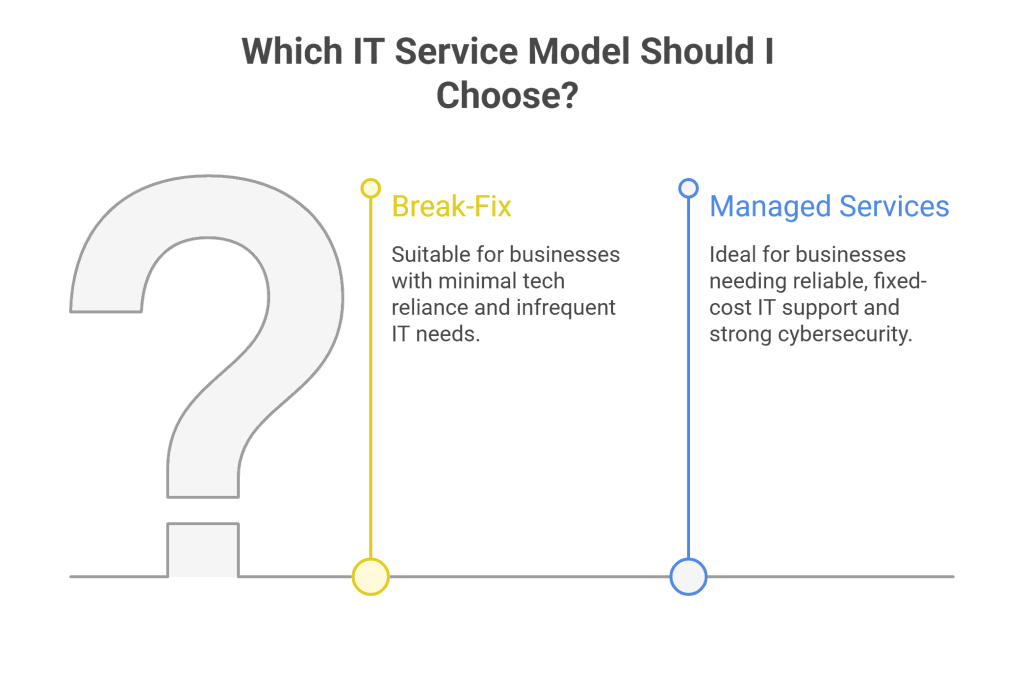
Break-fix might still work for you if:
- You don't rely on technology for daily operations.
- You have no sensitive data to protect.
- You need help only once in a while.
However, this should not be your long-term plan. If you need reliable systems for customer support, payments, or compliance, break-fix puts you at risk.
Managed services are a better choice if:
- You want fixed monthly costs.
- You need fast, reliable IT support.
- You want stronger cybersecurity and fewer surprises.
If you're not sure what to choose, start with a network scan or consultation. This gives you a clear view of where your risks are and how to fix them.
How to Make the Switch Without Disrupting Operations
You can move from break-fix to managed services without stopping business or causing stress. Start small and go step by step.
Here's how to make the switch:
- Get a network checkup: Your provider will scan your systems and show you any hidden issues.
- Try a small pilot: Start with a few services, such as backups or helpdesk, and test how it works.
- Pick the right provider: With over 40,000 MSPs operating, you must carefully evaluate your options. Look for 24/7 support, security expertise, and industry experience.
- Ask what to expect: A good provider will explain how they onboard you, organize your systems, and support your team.
OXEN Technology offers a complimentary 30-minute consultation to help you get started.
Key Functions Covered by Managed Services (but Missed by Break-Fix Services)
Many parts of your technology are likely unsupported if you rely on break-fix. This can lead to weak points in your network that affect your operations.
Managed services cover these important areas by default.
| Function | Break-Fix | Managed Services Covers |
| 24/7 System Monitoring | No | Yes |
| Security Patching and Updates | No | Yes |
| Endpoint Protection and Threat Detection | No | Yes |
| Cloud Backups and Recovery Testing | No | Yes |
| Employee Security Training | No | Yes |
| Compliance and Documentation | No | Yes |
| SLA-Backed Response Times | No | Yes |
Switch From Break-Fix Services to Proactive IT Management with OXEN Technology
Deciding between break-fix and managed services is about how you want to run your business.
Break-fix may feel easier, but it often leads to bigger risks, more problems, and higher costs. Managed services give you control, security, and peace of mind.
OXEN Technology supports over 2,500 end users and resolves 71% of IT issues on the first call. We provide dependable managed services that help your business run better.
Trusted Managed Services Near You |
||
| Kansas City | Omaha | Wichita |
Get in touch with us today to request a network scan or schedule your 30-minute consultation. Let's talk about how managed services can help you.