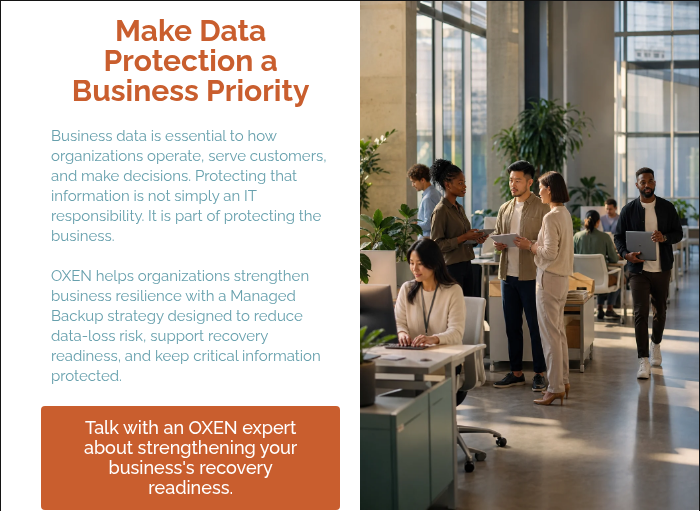

From Data Protection to Business Resilience: The Executive Value of Managed Backup
The value is backup isn't measured simply by how much data an organization protects.
Its real value becomes clear when something goes wrong.
Can employees still access the information they need?
Can critical processes continue?
Can the organization respond confidently rather than trying to determine what was the protected after the fact?
Can leadership make informed decisions about what comes next?
Those questions demonstrate why backup is more than a technology conversation.
It's a business resilience conversation.
Business Resilience Starts Before Disruption
Organizations can't predict every disruption.
They can decide how they prepare for one.
That's an important distinction for leadership.
A reactive approach begins solving the problem after data or systems become unavailable.
A more strategic approach identifies what matters to the organization beforehand and considers how those assets should be protected.
That means understanding which systems are essential.
Which data employees depend on.
Which processes affect customers.
Which information supports financial and operational decisions.
And where extended disruption could have the greatest effect on the organization.
These questions that should first be asked during a crisis.
They should help shape the organization's data-protection strategy today.
Connect Data Protection to Operational Continuity
Executives naturally evaluate investments based on their contribution to the business.
Managed Backup should be considered through the same lens.
Its value isn't simply the technology performing the backup.
It's the role data protection can play in supporting operational continuity.
Consider how interconnected modern business operations have become.
Teams depend on technology to communicate.
Employees need information to perform their work.
Customer relationships rely on accessible records and systems.
Leaders depend on accurate information when making decisions.
When important data or systems become unavailable, those dependencies can quickly become visible.
That's why leadership should understand where technology risk and operational risk intersect.
Visibility Creates Confidence
Good executive oversight isn't about having every technical detail.
It's about having the information necessary to make sound decisions.
The same principle applies to backup.
Leadership should understand:
-
Which information is critical to the organization
-
Which systems support important business functions
-
Where significant operational dependencies exist
-
What recovery expectations the organization opearates.
-
Supporting Organizational Confidence
That visibility creates better conversations between business leadership and IT.
Instead of discussing backup purely as technology infrastructure, both sides can focus on an outcome they share:
Keeping the organization resilient.
Protect the Most Important Business Functions First
Every organization has priorities.
When thinking about backup and recovery, those priorities should help guide strategy.
Which business functions have the greatest operational importance?
Which systems directly support those functions?
Which information would create the greatest difficulty if it became unavailable.
Answering those questions can help an organization better understand where its greatest dependencies lie.
It can also reveal that not every system necessarily requires the same approach.
The point isn't to make backup more complicated.
It's to make the strategy more intentional.
Resilience Is a Leadership Priority
Business resilience isn't solely an IT responsibility.
IT plays an essential role, but the priorities behind the resilience ultimately come from the business.
Leadership determines what's critical.
Leadership understands the organization's tolerance for operational disruption.
Leadership balances risk with investment.
And leadership establishes the priorities that technology should support.
This is why conversations about Managed Backup become more valuable when business leaders and IT decision makers approach them together.
IT provides insight into the technology environment.
Executives provide context about business priorities.
The result is an approach focused on protecting what matters most to the organization.
The Organization Will Keep Changing
Data-protection strategies should not remain static while the organization changes around them.
Businesses adopt new systems.
Operations expand.
More processes become digitial.
More information is created.
Customer expectations evolve.
The technology employees depend on today may look very different from what they depended on several years ago.
That makes periodic evaluation important.
Leadership and IT should ask:
-
Has our business changed?
-
Have our most critical systems changed?
-
Have our recovery expectations changed?
-
Does our data-protection strategy still reflect those realities?
Those questions help keep backup aligned with the organization rather than simply maintaining the status quo.
From Backup Strategy to Business Strategy
Managed Backup may be a technology service, but its ultimate purpose extends beyond technology.
It supports something larger:
The organization's ability to protect the information it depends upon.
That makes backup part of a broader strategy around risk, preparedness, operational continuity, and resilience.
The conversation doesn't have to be complicated.
Start with what matters to the business.
Understand the systems and information behind those priorites.
Establish realistic recovery expectations.
Then make sure the approach to data protection reflects them.
OXEN helps organizations make that connection, bringing data protection and business priorities together through a Managed Backup approach centered on what the organization needs to protect.
Because the objective isn't simply having another copy of the data.
It's building the confidence that the business is better for what comes next.
Strong. Simple. Trusted.
Talk with OXEN about how Managed Backup can support your organization's protection, recovery, and resilience priorities.